Share the wonder of nature with your kids!
Teach them what plants are safe to pick and eat outside and which ones aren’t.
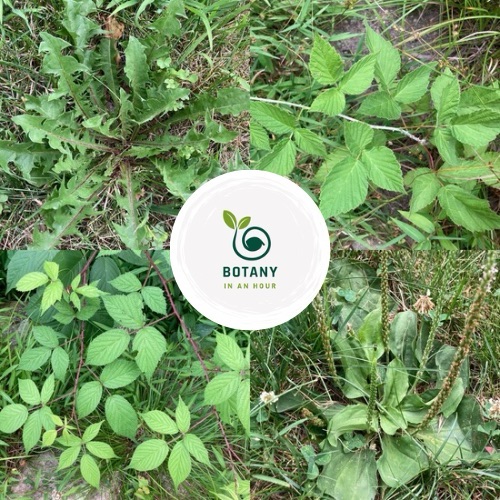
Start with these 8 easy to recognize plants that might be growing right in your backyard!
Berries: The Sweetness of Nature
Blackberries and Raspberries

Scientific Names: Blackberry (Rubus species); Red Raspberry, Rubus idaeus; Black Raspberry, Rubus occidentalis; Purple Flowered Raspberry, Rubus ordoratus
Plant Family: Rose Family (Rosaceae)
Both Blackberries and Raspberries are leafy shrubs that are part of the Rose Family and can be recognized by their long, thorny canes, leaves with toothed edges, and five petaled (usually) white flowers with many stamens in the middle. Blackberries usually have green canes, whereas Raspberry canes can be green or purple, often with a white coating on the stems. Blackberries ripen from green to red to black. Raspberries ripen to red in the case of Red Raspberry, or from red to black in the case of wild Black Raspberry. You know that the berry is ripe when it pulls away easily. If there is resistance, it needs to ripen longer.
Harvest with long sleeves and gloves to protect from the thorny canes. Both Blackberries and Raspberries can be slightly tart and astringent on the tongue which makes them delicious candidates for pies and cobblers or preserved in jams and jellies. For Blackberry recipes, I recommend the June 2025 edition of the Homestead Kitchen Magazine (affiliate link) which is full of delicious ideas of how to use your fruit should you come across a windfall of berries.
Both Blackberries and Raspberries are very safe to harvest because they are hard to confuse with other plants. Multiflora Rose (Rosa multiflora) is about the only plant that can be mistaken for either of these plants when in flower, and it would soon become clear that it is neither Blackberry or Raspberry because no fruit would develop. Blackberries can sometimes be confused with Mulberries and vice versa. Mulberries and Blackberries do look similar, but Blackberries grow on shrubs and Mulberries grow on trees. The only other confusion could be mistaking red, unripe Black Raspberries for Red Raspberries since the Black Raspberries ripen from red to black, but the firm texture of the unripe Black Raspberry, and tart flavor would soon correct your error.
Mulberry

Scientific Name: American Mulberry, Morus ruba; Asian Mulberry, Morus alba
Plant Family: Mulberry Family (Moraceae)
Mulberries, except for the Asian white Mulberry (Morus alba), look very much like huge Blackberries. The difference is that Mulberries grow on a tree and Blackberries on a shrub. Mature trees can reach 40-60 feet in height. The bark is grayish brown with yellow or orange colored fissures, and dense branches coming out in all directions. Leaves can be heart-shaped or lobed with toothed edges. The lobed leaves can sometimes be confused with Sassafras when no fruit is present, but Mulberries possess toothed leaf edges and the edges of Sassafras leaves are smooth. Sassafras also has a unique scent that would immediately distinguish it from Mulberry.
The easiest way to harvest Mulberries is to lay a cloth or tarp on the ground and shake the tree so that the ripe berries fall to the ground. The folds of the cloth can then be gathered and the berries easily brought into the kitchen for washing and sorting. Mulberries can be eaten straight off the tree or brought into the kitchen for jam, pies, or ice cream. Dehydrated mulberries are a pleasant addition to breakfast cereals or baked goods.
Blueberry

Scientific Name: Highbush Blueberry, Vaccinium corymbosum; Lowbush Blueberry, Vaccinium angustifolium
Plant Family: Heath Family (Ericaceae)
Blueberries grow on large shrubs with oval leaves with pointed tips and smooth edges. Some species have leaf edges with very, very fine teeth. The fruit usually ripens mid to late summer.
Distinguishing Blueberries from other similar plants is important since there are other plants that have bluish black berries that are toxic. Plants that contain blue berries that should not be eaten include Pokeweed, Virginia Creeper, Nightshade, and some species of Juniper. Beware of these blue berries and be sure that you have a positive identification before consuming any berries in the wild. Pokeweed and Nightshade are the most likely candidates for confusion, but in and of themselves are easy to differentiate since Nightshade grows on a vine, as does Virginia Creeper, and Pokeweed is a huge, umbrella shaped plant that can grow taller than you. So, once you clarify that blue berries should only be harvested from a shrub, you’re good.
Other blue berried plants that are cousins of Blueberries that are safe to harvest and eat are Huckleberries (Gaylussacia sp.) found in the Pacific Northwest, Mayberry (Vaccinium elliottii) found in the deep South, and Bilberry (Vaccinium uliginosum and Vaccinium cespitosum) found in northern Canada and the Pacific Northwest.
Blueberries can be eaten fresh or used in baked goods like pies, muffins, or pancakes. They really shine when made into a compote or jam. Blueberry Earl Grey jam is one of my favorite uses.
Other Edible Berries:
I have purposefully not included other often found berries here like Elderberry and Cranberry because Elderberry cannot be eaten raw and because Cranberry has similar poisonous look-alikes which might be hard for a young child to distinguish. Therefore, I don’t consider these two plants as beginner plants for inexperienced, young foragers. The berries covered above are easy to recognize and except for possibly mixing up Blueberry with Nightshade and Pokeweed, have no dangerous look-alikes.
Wild Edible Flowers and Greens:
Plantain

Scientific Name: Broadleaf Plantain, Plantago major; Narrowleaf or English Plantain, Plantago lanceolata; American Plantain, Plantago rugelii (native); Heartleaf Plantain, Plantago cordata (native and endangered)
Plant Family: Plantain Family (Plantaginaceae)
You may be confused if you think that Plantain is shaped like a banana. That is a different plantain. The green, leafy Plantain that we are discussing here is a perennial green with broad, oval leaves that grow in rosettes that hug the ground. Flowers and seed stalks are leafless and shoot up from the center of the rosette. Leaves can be harvested throughout the season by pinching leaves at the base to pick one leaf at a time, leaving the root to preserve future harvests. Plantain seeds should not be eaten directly as they are so high in fiber that large amounts of water must be consumed with them. Leave the seed heads to allow the patch to spread.
Plantain is very safe to eat and is not easily confused with other plants. Mullein, dandelions, some thistles, and Evening Primrose also grow in basal rosettes, but the leaf structure of each is so different from plantain that the risk of confusion is low. Eat the young leaves of Plantain as older leaves can be tough to chew. The mouthfeel is quite astringent and drying so use mixed with other greens for the best results.
Dandelion

Scientific Name: Taraxacum officinale
Plant Family: Aster Family (Asteraceae)
Dandelion is a perennial with bright yellow composite flowers that grow everywhere! The flower stalk is leafless and it possesses a deep taproot which anyone who has ever tried to pull one from their lawn would know. The leaves form a basal rosette with each leaf being long and often deeply lobed with toothed margins. There is wide variation of leaf shape between species but it is not necessary to distinguish between them.
All parts of the Dandelion plants are edible. It is best to harvest the leaves in the early spring before the flowers open. They can be harvested later in the summer, but the leaves may be bitter. The flowers are edible as well and roots can be harvested at any point. The plant regrows from any tiny piece of the root that is left in the ground and it spreads easily from the fluffy seed heads, the entire plant can be harvested without affecting future harvests.
There are many plants that look similar to Dandelion, but most are edible as well. The main point of differentiation from other similar looking plants is that the points of the dandelion leaf’s tips point straight out or back towards the base of the plant rather than towards the tip of the leaf. If you are uncertain, wait until flowers open to be certain of the plant’s identification.
Dandelion flowers can be added to salads or breaded and fried as fritters. Leaves can be eaten raw in salads and are highly nutritive. Roots can be cleaned, roasted, and brewed as a coffee substitute. You may want to avoid eating Dandelion if you have ragweed allergies or are allergic to chamomile or other Aster Family plants.
Wild Violet

Scientific Name: Viola species
Plant Family: Violet Family (Violaceae)
Wild Violets are a perennial, North American native flower that loves to grow in shady woodland areas, but will grow in full sun as well. It is found readily throughout the eastern United States. Fewer species are found in the West.
It grows from a basal rosette of leaves which are sometimes heart shaped, and has nodding flower heads with slightly irregular, 5 petaled flowers. The top petal is slightly larger than the two side petals and the two lower two petals. Flowers vary in color and can be deep to light purple, blue, white, and rarely yellow.
Violet flowers can be collected in the very early spring. Leaves are edible and can be harvested anytime. Because the plant spreads by seed and rhizome, the leaves and flowers can be harvested freely without harming future harvests. Violet flowers and leaves can be eaten fresh in salads, and the flowers can be made into sodas, ir used as a decoration for spring desserts.
Other purple flowered plants that are toxic also bloom at the same time of year as violets. The main one being Periwinkle (Vinca minor) which also has five petals. They can be distinguished easily however as the petals of Periwinkle are all the same size and it grows on deep green vines with elliptical shaped leaves rather than the wide heart shaped leaves of violets. Teach your kids to distinguish between the two before picking and eating purple flowers. African Violets are also toxic and are a completely different plant than the Wild Violet that we are discussing here. They should not be eaten.
Garlic Mustard

Scientific Name: Alliaria petiolata
Plant Family: Mustard Family (Brassicaceae)
Garlic Mustard (or Jack-by-the-Hedge as it is known in the United Kingdom), is a prolific biennial that reseeds easily, and grows worldwide. In the United States, it is found in the Eastern and Middle U.S. north of Texas, the Pacific Northwest and Southern Canada.
It can be recognized by its rounded or heart-shaped leaves. They have deep, branching veins that form a netting pattern on the leaf. The leaves are arranged in a basal rosette and the leaves have edges with rounded teeth. The plant has a strong garlic/mustardy scent. White, four-petaled flowers appear during the second year of growth. The leaves on the flower stalk alternate position up the stem and the leaves on the flower stem are a more triangular shape from the heart-shaped leaves that are found at the base of the plant.
The leaves can be harvested at any time. Young stems should be harvested before flowers open for a milder flavor. Summer heat can cause the leaves to have a bitter flavor, so harvest in spring or fall for best taste.
The heart-shaped leaves can sometimes be mistaken for Violet leaves, but Violet leaves are tasteless and will lack the strong garlicky aroma and flavor of Garlic Mustard. The good news is that both are edible, so there is no harm in confusing them. The leaves of Garlic Mustard can be eaten raw or cooked and used as a wild green. Mix with other greens if the flavor is too strong. Can also be used in sauces, pesto, or smoothies for a nutritious boost.
Common Sense Harvesting Tips:
- Don’t ever harvest from any areas that may have been sprayed with pesticides.
- Only harvest from your own property or land where you have express permission from the owner.
- Teach your kids never to pick and eat anything without asking you first.
- Don’t eat any plant that you aren’t 100% sure of its identification. Ask in a professional plant ID group on Facebook when in doubt.
- Pay attention to what parts of this plant should be harvested for eating and for ensuring the plant’s survival for future harvests.
Get your kids off the screens and out into nature!
Take them outside and teach them something that you wish someone had taught you when you were a kid!
Register for the Basic Course and you will…
- Feel Confident to know exactly what you need to teach your kids so that they can recognize plants independently.
- Learn how to introduce each group of plants to the kids in 3 easy steps.
- In less than an hour, you’ll be outside with your kids exploring nature and maybe even harvesting some edible plants!
Get outside, make some memories, and give your kids skills that they can teach to their own kids someday!
FREE Downloads:
Check out our free downloads so that you can find out about the Best Botany Resources for recognizing and harvesting edible wild plants.
Leave a Reply