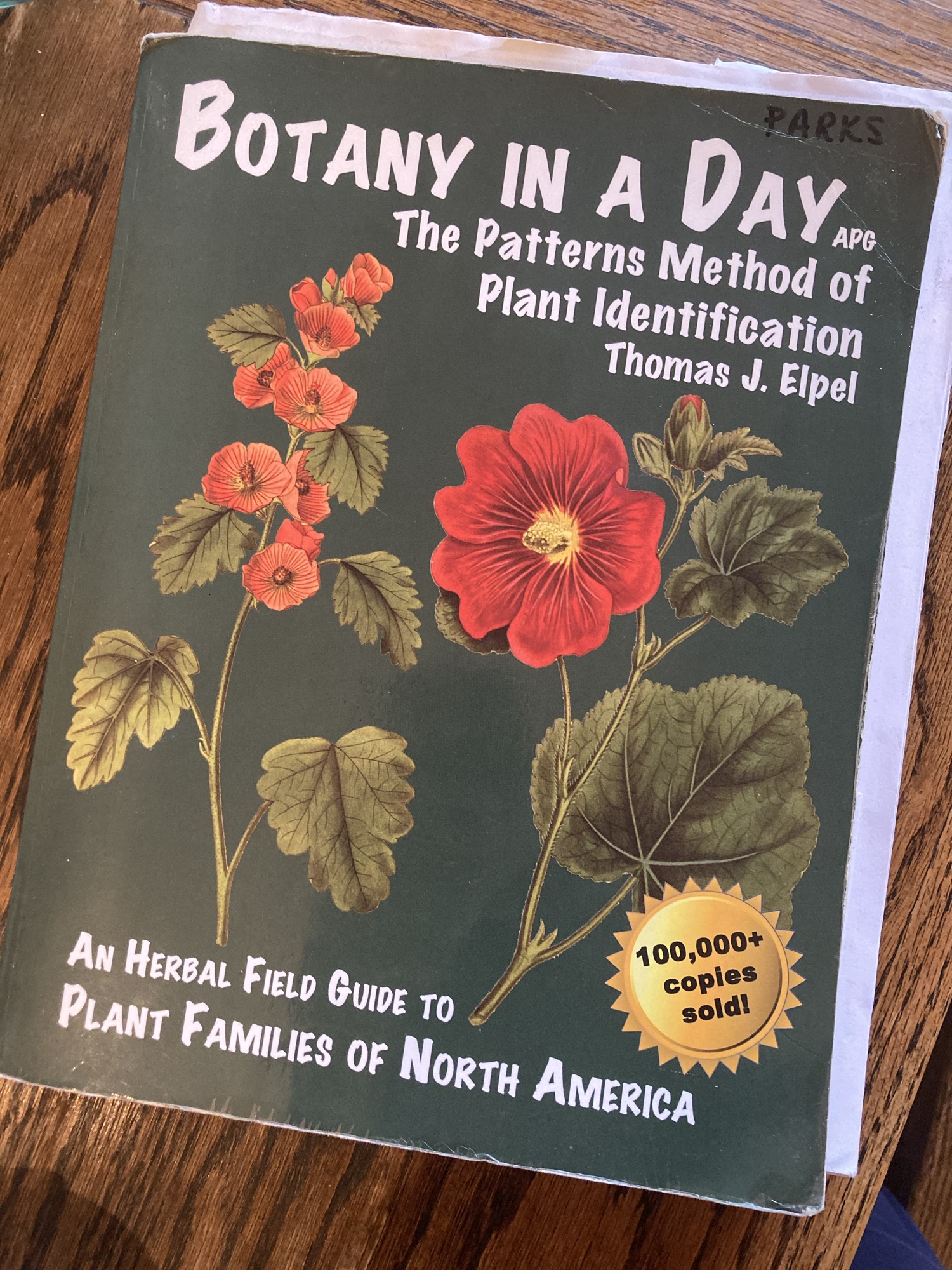
The Keystone Book for Plant Identification!
When it comes to learning plant identification, most field guides organize plants by flower color or alphabetically, requiring you to look up each plant individually, and in the end, memorize thousands of individual plant species. But what if there was a more efficient approach? Enter Botany in a Day by Thomas J. Elpel, a guide that revolutionized how I learned to identify plants.
I never got very far with plant identification guides before I found Botany in a Day. I tried using traditional field guides, but I’d either get stuck on a term that I didn’t know when trying to use the identification keys, or I would end up at a dead end when something that I needed to see to move forward in the key was not visible, which is often the case with perennials that only bloom once per year. Once I found this book and dug into it, my plant ID skills were transformed. Let me show you how Botany in a Day helped me, and how it is a masterpiece of botanical information.
How Botany in a Day Transformed My Plant ID Skills
I received Botany in a Day as either a Christmas or birthday a gift somewhere between 2016 and 2017. I can’t remember exactly now. At the time, I had just moved from New York City to a house with a few flower beds and my aim was to create beauty around me and become friends with all the flowers.
I dug in. I admit, it was intimidating. The book isn’t terribly easy if you don’t have a botany background, but thankfully I had just started teaching botany at our local homeschool coop and my teaching skills and plant ID skills grew together.
I starting using the book, trying to incorporate what I was learning into my botany class. Two years later, I had developed an entire method for teaching plant identification to 3rd and 4th graders as well as their parents and siblings (when you homeschool, you end up teaching the entire family).
While I was learning how to identify plants and teaching them to my in-person students, I also found that my new found knowledge of plant families was becoming invaluable in my personal life. You see, my children and I have always had some very unusual food and plant allergies. They always seemed completely random. But, this book has illuminated the reasons behind why we react badly to certain foods. Why does my son break out in hives when he consumes chamomile, sunflower, yarrow, and fenugreek? Come to find out, they are in the same plant family – the Aster Family. Why do I react badly to alfalfa and anything with licorice? They are related as well. They are both in the Pea Family. This spurred me on and I dived deeper.
I started finding all sorts of connections between foods that we I knew that we could not eat, and related plants that we didn’t know were making us sick. Botany in a Day has not only helped me grow in my own gardening and foraging skills, but in my ability to care for and feed my family.

Why Botany in a Day is the First Book I Pull Off the Shelf!
Even amongst stacks and shelves of plant books, when I encounter a new plant, whether with a friend, at a garden center, or in a book, Botany in a Day is the first book that I pull off the shelf to find out more. I immediately look up what plant family that new plant is in. This gives me a framework in which to place the plant. I come away knowing that “X” is in the “Y Plant Family.” And every time I see that plants or ones related to it, I can see the characteristics that identify it and I’m constantly honing and adding to my plant identification knowledge. Then when encounter a plant unknown to me, my eye is already trained to recognize the characteristics of that plant family, and I can identify it for what it is. This allows me to draw conclusions regarding whether that plant is edible, possibly poisonous, or potentially medicinal.
Why Botany in a Day is Superior to Other Plant ID Books
Unlike conventional field guides that require memorizing individual species, Botany in a Day uses an approach focused on learning the identifying characteristics that apply to whole groups of plants. The core premise is quite simple, but extremely powerful, because when you learn to recognize the core characteristics of a plant family, then you suddenly know how to identify hundreds or thousands of plants all at once. This is the genius behind this book.
The Structure of the Book
The book teaches you to identify the eight most common plant families, which would effectively allow you to be able to identify over 45,000 plant species not just across North America, but throughout the world. By learning these core plant families you can immediately recognize by sight, nearly 70% of the plants that you would commonly encounter.
The book outlines each family’s defining pattern using the following plant parts:
- Leaf arrangement
- Structures and patterns of flower parts
- Characteristics of stems
- Growth habits
- Shared botanical features
The information can be learned by anyone with some basic botanical knowledge.
So, does it measure up? Can you really learn botany in a day?
Many people often wonder whether Botany in a Day truly lives up to its name. Can you really learn botany in a day? The answer? Yes and no.
The fundamental system of plant recognition by plant family characteristics can indeed be understood in a day of focused study. However, like any skill, digging through each plant family group takes time and practice. The book does not provide instant expertise, but a framework for learning plant identification that will take you farther than any traditional field guide ever could.
Comparing Botany in a Day to Other Identification Methods
| Approach | Learning Method | Time Investment | Scale |
| Traditional Field Guides | Memorize individual species | High | Limited to specific region |
| Plant ID Apps | Algorithmic recognition | Low | Inaccurate and dependent on technology |
| Botany in a Day | Patterns method recognition by plant family | Initially moderate, low long-term | Application Worldwide |
The family pattern approach creates transferable knowledge that works across the world and gives you a base of knowledge that you can use in any location..
Bottom Line: Is Botany in a Day Effective?
After spending years applying and teaching the methods taught in Botany in a Day, I can honestly say this book is the most effective and efficient method for learning plant identification. It is gives you a vast knowledge base with a minimal investment of time. Best of all? Anyone can learn it. You can learn the plant family characteristics just as easily if you are four-years-old, or eighty-four years old. It’s a skill that you can use your whole life long. Whether your goal is to up your gardening game, grow more food for your family, forage and harvest what is free around you, or help your family manage complicated food allergies, this book is worth it. The pattern-recognition skills it teaches transform what could be an overwhelming challenge of memorizing one plant at a time, into an engaging process of discovery.
What ultimately makes Botany in a Day a masterpiece isn’t just the efficiency of its method, but how it changes your relationship with the plant world. You begin to see patterns everywhere, recognizing plant families in your garden, on hiking trails, and even in the produce section of your grocery store. This heightened awareness allows you to contribute to the world in which you live in a way that you couldn’t before. The benefits extend far beyond the skill of plant identification.
Where to Buy Botany in a Day
The current edition of the book can be purchased directly from Elpel’s website, HOPS Press. Older editions can be purchased used online, but my recommendation is to purchase the latest edition from Amazon..
Note: This post contains Amazon affiliate links. This means if you use one of these links to purchase the book, I will receive a small commission.
Final Thoughts: Transform Your Botanical Education
Botany in a Day represents more than just another identification guide—it’s a fundamental rethinking of how botanical knowledge can be learned and taught to others. By focusing on the characteristics of plant family groups rather than memorization of individual species, the book provides a system that is accessible to anyone willing to learn
Worried that you don’t have the basic knowledge needed to succeed with Botany in a Day?
Don’t worry. We’ve got you covered. Download our Free Botany Basics Guide to learn the core skills that you need to know to identify any plant in the world. It’s simpler than you think. It’s what I use with my 3rd and 4th grade students and most of them come into class knowing these Botany basics already.
Do you already own Botany in a Day and struggle to make use of it on your own?
If Botany in a Day has been sitting there on your shelf unused year after year either because you don’t have the time or a the botany background you need to easily dig into it, then let me help. I can take the difficulty away and make it feel easy. Let me show you what features of the book to focus on so that it will become your most used plant identification book. With a few simple steps, I can show you how to take Botany in a Day and make efficient use of it so that you’ll be able to effectively study any plant family on your own. Check out my Basic Course, and learn the secret method to using the book that feels backwards and counter-intuitive, but is so effective. By the end of the hour that it takes to complete the course, you’ll know how to make effective use of this invaluable book.
Leave a Reply