Most people give up on plant ID before they even really get started. They find a plant they don’t know and they use a plant identification guide and plant ID key to try to work through the key to narrow down the species of the plant. But, they never make it to the end.
Why? They get stuck because, almost always, there is a plant part that they can’t see either because they don’t know what it is, or it’s the wrong time of year to observe it, so they think they can’t do it and give up.
But in the back of their mind there is lingering disappointment. Secretly, they still wanted to be able to work out that plant, and they don’t know what to do in order to be better at identifying plants.
How to Improve Your Plant ID Skills Today
Are you stuck here? Have you resorted to plant ID apps, or the camera on your phone to tell you what a plant was, not really being sure that you could trust that AI was telling you?
You’re not alone. Many people don’t know how to improve their plant recognition skills without putting in hours of study so that you’d basically be getting a Botany degree in order to make any progress.
So what is the one thing that you can implement today that will improve your plant ID skills?
Study a Plant that You Already Know
I know, I know. You don’t have to say it. I know what you are thinking. You’re wondering why you would want to study a plant that you know already in order to get better at identifying plants that you don’t know.
Stick with me a moment. There is a method to my madness. The key to being good at identifying plants isn’t being able to work through a plant key, find your way around a plant identification book, or even memorizing what thousands of plants look like.
What is the key skill that you need in order to be good at recognizing plants by sight? You need to train your eye to be able to see the plant parts.
Key Skill for Plant Identification: Observation
So the key skill for being a good at plant identification isn’t memorizing lots of plants, it’s training your eye to observe the parts of the plant. So, the next question you should ask is “How can I do that?”
The Answer: Start with a plant that you already know.
Why would you want to identify a plant you know already?
When you start with a plant that you know already, you are beginning with something that you already recognize. This is important as you train your eye to distinguish the plant parts that you need to know in order to be good at plant identificaiton.
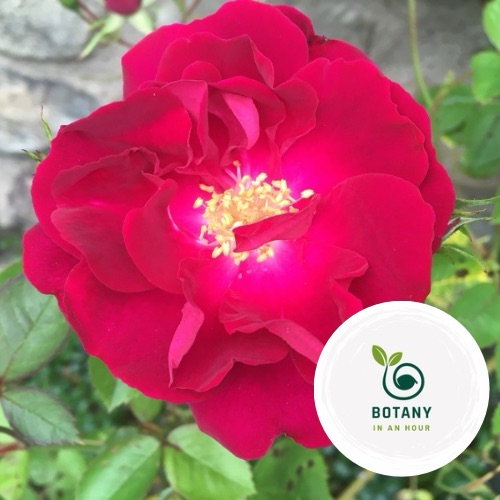
Let’s use Rose as an example. Consider the photo below. Look at it for a moment and fix in your head the plant parts that you are able to see. Name them to yourself before scrolling on.

What flower parts do you see in this photo?
Answer: Lots of petals and lots of stamens.
What about this photograph?

Answer: If you look carefully, you can count 5 sepals.
Now if you don’t know what sepals are, or can’t see them, don’t feel badly. I’ve got a download at the end that will tell you exactly what plant parts you need to know in order to be good at plant identification.
What Seeing the Flower Parts Can Tell You
When you train your eye to see the parts of the flower instead of just memorizing what individual flowers looks like, you’ll soon see patterns amongst plants that are related to one another.
So, what should you do in order to get better at plant identification today? Follow the steps below and you’ll be on your way to recognizing thousands of plants. You can even take our bonus quiz at the end and see if you can see the similarities between some of the plant groups in the quiz.
How to get better at plant identification on your own!
Follow these steps to improve your day to day plant recognition skills:
- Find a flowering plant that you know what it is already. Live specimens are better than photos, but if all you have is a Wikipedia, a Google image search, or plant and seed catalogs, work with what you’ve got.
- Examine the flower of your choice, and name the plant parts that you can see. (Grab our free Botany Basics download below if you aren’t sure what plant parts you need to look for.)
- After pinpointing the plant parts that you can see (petals, stamens, pistols, etc.), look up this plant in a flower or gardening book that you already have on your shelf, or Google the flower and click on the Wikipedia article for that plant and note the plant family that this flower belongs to. (Example: Aster, Rose, Mint, etc. Latin names may be given instead like Asteraceae, Rosaceae, or Lamiaceae.)
- The next step is to Google the plant family for the plant that you just looked up and look at pictures. Search Aster Family, Rose Family, Mint Family, etc. and click on “Images” in your browser. Scroll through the pictures of the plants that come up noting the similarities that you see in them. (In general, I don’t advocate using AI or plant ID apps for identifying plants, but in this case, you are using Google as a study tool.) Once you have noted the similarities, you’ll notice that these similarities in the look and patterns of flower parts apply not just to the plant that you started with above, but to other plants in the same plant family as well.
- Write down any plants that you discover that are also in the same plant family as the plant that you started out studying.
- Guess what? You just learned how to recognize a whole group of plants all by yourself. You’ve trained your eye to the patterns of this plant family and now that you know what to look for, you’ll never be able to unsee it.
Let’s Practice Plant Identification
Let’s practice learning a new group of plants by going through the steps above together.
- Choose a Flower that You Know: Let’s start with something we are all familiar with – a Rose. Look at the image above.
- What flower parts can you see? I can see the numerous petals and stamens in the photo of the rose above.
- Look up the plant family: If I look up this flower or google it, I’ll learn that it is part of the Rose (Roseacea) Family.
- Look up in a book or Google images of plants in this plant family and note their similarities: If I Google “Rose Family” and start scrolling, I’ll see many plants that look similar with a number of petals and lots of stamens in the middle.
- Write down any plants that you discover are related to the plant that you started with: I see that Strawberries, Raspberries, Blackberries, Peaches, Almonds, and Cherries are all part of the Rose Family.
- You can now recognize many more plants by their common “look” and characteristics: I know now that all the flowers that look like Roses with many stamens in the center and lots of petals are possibly part of the Rose Family. If you were able to actually observe an actual specimen, you might also not that Rose Family plants have 5 sepals as well.
What flower parts are essential for plant identification?
Don’t second guess yourself. Grab our free Botany Basics Guide to see the parts of the flower that you really need to be able to recognize to be able to identify any flowering plant.
Still not sure you can ID plants correctly? Learn the 10 Questions you can ask yourself to identify any flowering plant. Grab our free download!
Test your Plant ID Skills! Can you guess the plant family for these plants? Take our Plant ID Quiz!
Want to learn more? Check out our Basic Botany Course!
Learn the 4 biggest plant families that are most commonly found around the world. By the end you’ll be able to recognize over 40,000 plants!
Leave a Reply